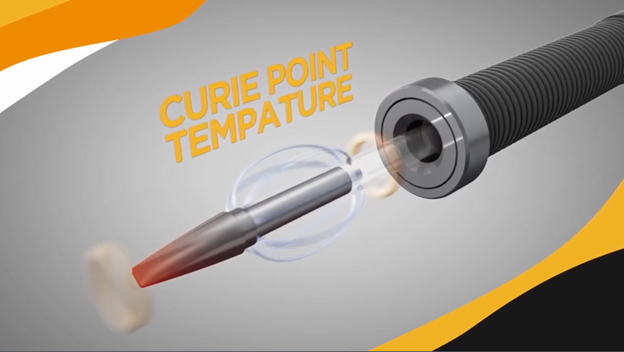
We often get detailed questions from Process Engineers about how SmartHeat® really works, and whether fixed (or stable) head soldering stations or variable heat is what they need.
The Basics of SmartHeat® and the Heater Elements
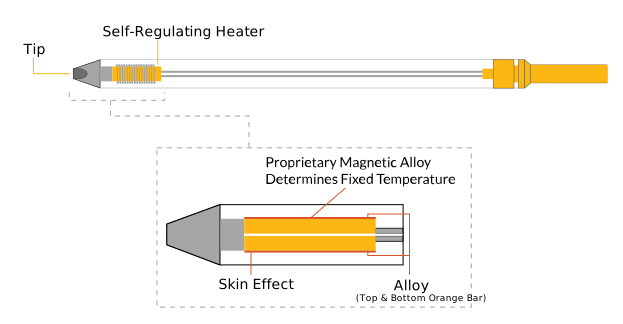
SmartHeat® heaters consist of two basic elements; a high-frequency alternating current (AC) power supply, and a heating element. The biggest difference between a conventional soldering station which consists of a ceramic or wire wound heating element, separate sensor and temperature control circuitry, and a Metcal heater is that the Metcal heating element itself is capable of heating and then maintaining a predetermined temperature. In other words “the heater is the sensor.”
The Metcal heater depends upon the electrical and metallurgical characteristics of two different metals; copper is a material with high electrical conductivity and the other is a magnetic material with high resistivity.
When the Metcal heating element is energized by the high-frequency alternating current (AC) power source, the current will automatically begin to flow thru the conductive copper core of the heater. However, as the AC current continues to flow, a very useful physical phenomenon occurs, the current flow is directed to the skin of the heater assembly. This is of course known as the “Skin Effect”, it drives the majority of the current through the high resistance magnetic layer, causing rapid heating.
The Curie Point
As the outer layer reaches a certain temperature (which is controlled by its heater alloy formula) it loses its magnetic properties. As most of you know this “certain temperature” is the Curie point. The Curie point temperature is when the “skin effect” begins to decrease again, permitting the current back into the conductive core of the heater starting the whole cycle over again.
The selection of a material with a fixed Curie point results in a heater that will produce and maintain a specific, self‐regulated temperature; and a heater that requires no calibration and responds directly to thermal loads. When a thermal load is applied to the tip, the heater temperature drops, and the power supply responds with the power required to correctly solder the joint on the board.
The Cruise Control Analogy
 We all know that SmartHeat® responds to changes in the thermal loads of a solder joint and cruise control responds with the correct amount of power to complete the operation, the same way your car’s cruise control maintains the set speed over a long drive. Here the vehicle controls are similar to the SmartHeat® system; your cruise control is your fixed temperature cartridge and your tachometer is similar to a net power meter.
On level ground, you set the cruise to 70 mph, as your car encounters hills and valleys the cruise control works to vary the output power of the engine to maintain that 70 mph that you set. How can you verify the engine’s changing output? It is very simple, look at your tachometer. As your route takes you up a hill the cruise control tells the engine to increase power (revs) to meet the 70 mph that you preset. At the top of the hill, you are still going 70, as you start down, the cruise control tells the engine to reduce the power (revs) so that you are not exceeding your preset and it saves you gas and hopefully from a speeding ticket.
Hope these explanations have you thinking about how SmartHeat® can work for your applications!
